People in our borough are priced out of feeding their family healthy, nutritious food. What if we could create a local food system that genuinely works for everyone?
Last winter, Stella* was in a very vulnerable situation. Priced out of daily essentials, she urgently needed support for her and her young daughter.
Asking for help felt terrifying. But the welcome she received at her local food pantry was warm and reassuring. At the pantry, Stella could do her weekly shop for under £5, choosing fresh fruit and vegetables, and options that were right for her and her daughter.
Stella is just one of an estimated 37,000 people who are food insecure in Islington. This means thousands of people are waking up each day unsure of where their next meal is coming from, or uncertain if they will have enough nutritious food to support a healthy and active life.
The increasing number of people in our borough experiencing food insecurity is driven by wider structural issues including rising living and housing costs – meaning that more people in employment are also struggling to afford the basics. And during the winter months, this gets even harder. When energy bills are highest, many people will have to choose between their weekly shop and heating or other essentials.
Stella is just one of an estimated 37,000 people who are food insecure in Islington. This means thousands of people are waking up each day unsure of where their next meal is coming from, or uncertain if they will have enough nutritious food to support a healthy and active life.
Food banks provide a lifeline but were never intended to be a long-term solution. A Guardian article from 2024 explored how food banks have become such a fixture of life in the UK, acting as a safety net for those in crisis. And Feeding Britain, along with the wider food movement, have highlighted for many years that while hunger is a structural problem, the response is often to just provide food.
“The current food bank model is not sustainable because it predominantly relies on donations to address a systemic issue of food insecurity caused by inadequate income and social support. ” Julie Parish, Octopus Communities.
Here in Islington, many food banks are buckling under the strain of supporting more people with fewer resources and donations. Staff and volunteers are often burnt out, giving their own time and money to collect donations and support those attending. Staff members said they were often using their own time and money to drive across London to pick up supplies or working long beyond their paid hours – in once case lifting heaving supplies up and down stairs due to a broken lift.
But across Islington, community organisations like the ARC Collective, The Peel, Mildmay Community Partnership and St Luke’s are working together to build a fairer local food system. A network of food pantries and social supermarkets are working alongside foodbanks, establishing sustainable, community-led solutions that help build community resilience for the long-term.
 How are food pantries different?
Food pantries or social supermarkets run on a membership model, charging around £3 per person or £5 to £7 per household a week. In exchange, members typically receive a basket of fresh, ambient, chilled, and frozen food (plus household items and toiletries in some cases) valued at upwards of £25 and often much more.
Through surplus food, partnerships with businesses and donations supplemented with bulk purchasing, food pantries can provide a balanced offering a fraction of the usual cost. This helps household budgets go further while preserving dignity and independence.
More than food, pantries are welcoming community spaces where people can enjoy a hot meal, find a listening ear, and access advice. They are often co-located or integrated with advice services, with staff on site who can assist members with benefits calculations, debt management, housing and employment.
As volunteers at the pantry gained Stella’s trust over the weeks, she began to open up and engage with other members. The team were able to refer her to advice and services around debt, mental health and supporting her daughter, with some advice services available at the pantry itself.
More than food, pantries are welcoming community spaces where people can enjoy a hot meal, find a listening ear, and access advice. They are often co-located or integrated with advice services, with staff on site who can assist members with benefits calculations, debt management, housing and employment.
One week, over a steaming bowl of home-made soup, Stella expressed a desire to get involved with her community and find an avenue for herself now that her daughter was starting nursery. With support from the team, Stella successfully applied to run art sessions at a local community group. She now leads a room full of people through creative practice each week.
Without the offer of nutritious, low-cost food – Stella would have never walked through the pantry door. But it was the warmth and guidance of the pantry volunteers that helped Stella to find a path out of crisis.
Supporting the transition to pantry models in Islington
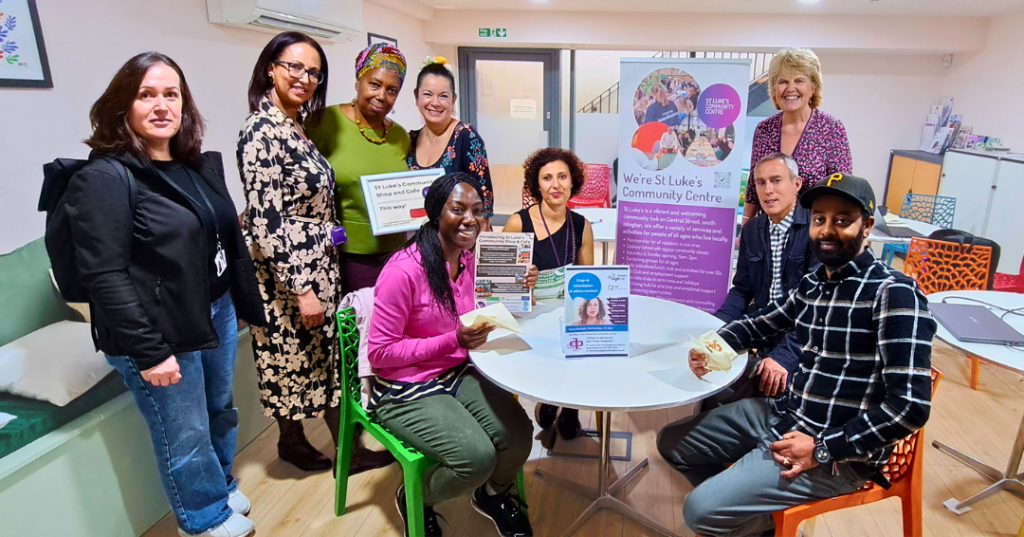
In 2025, with support from Google.org, Islington Giving funded five projects to make the transition to a food pantry or social supermarket model: the ARC Pantry, The Peel Community Food Club, Mildmay Community Food Hub, Manor Gardens Surplus Café and St Luke’s Community Shop.
The primary goal of ARC Collective’s transition from a food bank to a food pantry was to increase the number of people they can support. Their long-standing food bank, which served 300 people in 100 household a week, had been at capacity for some time.
“We were stuck at this 100 families per week limit. We had this insane waiting list, and that was really devastating.” – Arc Collective
 With funding from Islington Giving to transition to a membership model, The ARC Collective were able to onboard everyone on their waiting list. Introducing payment and a booking system, they now have 160 households who can book each week and no waiting list. “Anyone who can’t pay,” Asha Sumroy, Food Pantry Manager explains, “is referred into income maximisation support and given further free months, no one is turned away.”
As well as reaching more people, the ARC created a more sustainable model and offers better quality food and more choice. As well as choosing from pantry items, every household receives fresh fruit and vegetables, breads, milk and eggs, plus surplus items from a local bakery.
But Rhiannon is not just a pantry member. She has volunteered with the project for many years and remains a valued part of the community. Her story shows that people experiencing food insecurity are often already contributing to their neighbourhoods as workers, carers and volunteers.
One member is Rhiannon.* Rhiannon works locally in the NHS while also caring for one of her children, who has complex support needs. As the sole earner in her household, she finds that even working multiple jobs doesn’t provide enough financial security when unexpected costs arise.
Like many working families, Rhiannon’s need for support can vary from month to month. The pantry gives her the flexibility to access affordable food when she needs it, helping her manage rising living costs without the stigma or uncertainty that can come with crisis support.
But Rhiannon is not just a pantry member. She has volunteered with the project for many years and remains a valued part of the community. Her story shows that people experiencing food insecurity are often already contributing to their neighbourhoods as workers, carers and volunteers.
At its core, the aim of transitioning to this paid membership model was to increase the ARC’s ability to address the root causes of insecurity for their members and support more people to find pathways out of crisis.
“Reaching food security is a long-term challenge for many clients, and cannot happen in an arbitrary number of months,” explains Asha. “[The new model] increases the chance of clients actually being able to move security as opposed to just out of crisis.”
The ARC also report that the take up of support offered on-site by Age UK, Islington Council, and others, has improved now that clients feel welcomed to stay around the building and feel more able to share information about their current situations.
Building a resilient, community-led food model in Islington

Stories like Stella’s and Rhiannon’s remind us that food insecurity is about much more than food.
Since 2023, funding from Google.org has strengthened local responses to food insecurity across Islington, supporting both emergency food provision and longer-term approaches that help people access affordable food with dignity while building skills, confidence and community connections.
- £490,000 invested in local food projects between 2023 and 2026
- 41 organisations supported
- Growing investment in sustainable community food models, including pantries and social supermarkets
The organisations that have been part of this work are showing that community-led solutions can help ensure that everyone has access not only to affordable food, but to the support and opportunities that enable people and communities to flourish.
For Stella, it started with an affordable bag of shopping. What made the difference was everything that came after.
Over the coming year, with the support of our community, we will be continuing to fund local organisations, volunteers and residents working to tackle food inequality and build a fairer food system.
Please sign up to our newsletter to hear more about this work, or get in touch at mail@islingtongiving.org.uk
*name and some details changed for privacy